For decades, formal software verification has lived in a paradoxical space. On one hand, it represents the gold standard of engineering: the mathematical proof that a piece of software will behave exactly as intended under all possible conditions, free of bugs, race conditions, or security flaws. On the other hand, it has historically been so labor-intensive, computationally expensive, and mathematically demanding that only aerospace engineers, cryptographic protocol designers, and nuclear facility software teams could justify the investment.
Writing specifications for theorem provers requires a rare hybrid of software engineering talent and advanced mathematical logic. Every invariant must be meticulously stated, and every edge case must be manually bridged. Because of this steep barrier to entry, formal verification has largely remained sidelined in favor of traditional testing, integration suites, and post-deployment bug patching.
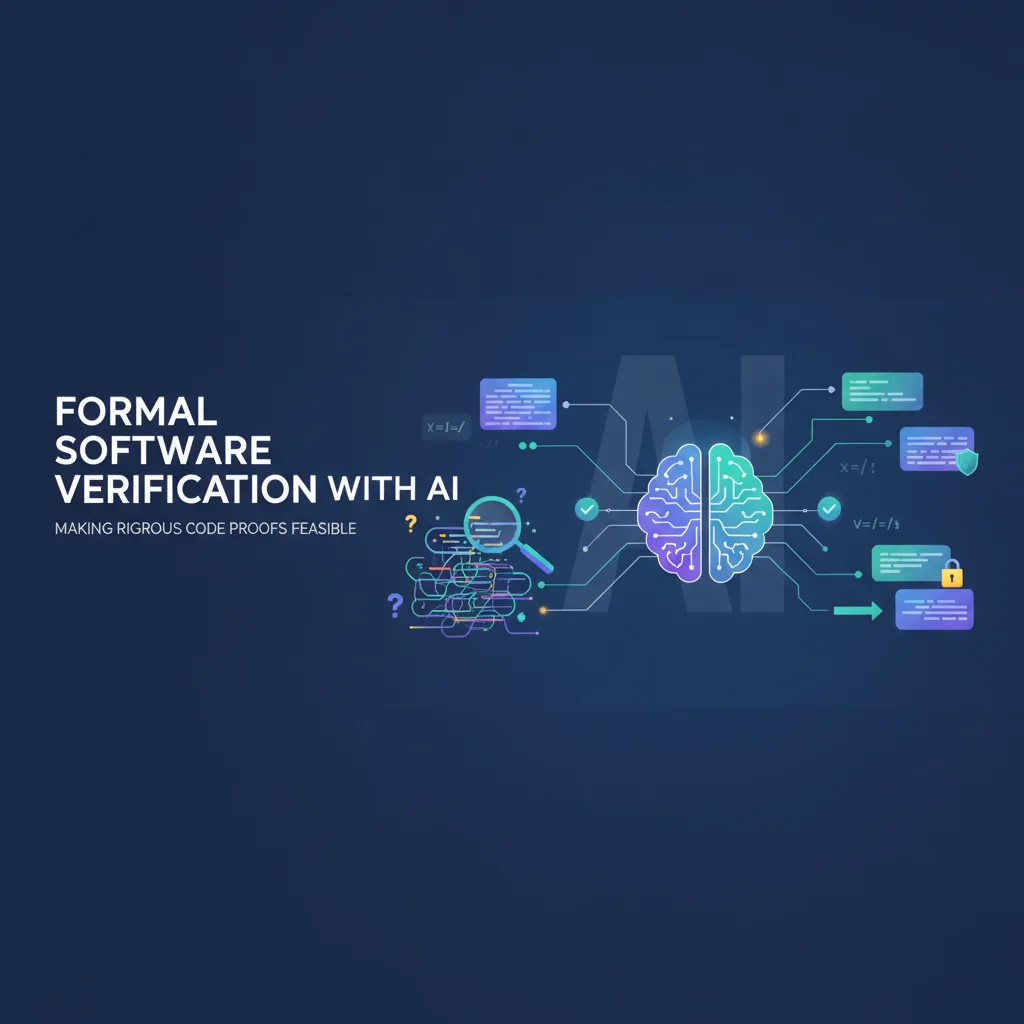
Today, that dynamic is shifting rapidly. As large language models (LLMs) and advanced machine-reasoning loops mature, developers are discovering that AI can bridge the gap between human intent and rigorous mathematical logic. Far from just generating boilerplate code or catching syntax errors, AI is beginning to automate the arduous process of writing formal proofs—making formal software verification scalable for everyday enterprise applications.
Why Traditional Formal Verification Hit a Wall
To understand why AI integration is such a breakthrough, it helps to examine why formal verification has struggled to achieve widespread adoption in commercial software development.
- Extreme Labor Intensity: Translating human business logic into machine-checkable mathematical theorems (using languages like Coq, Lean, or Dafny) often takes significantly more time and effort than writing the original code itself.
- Steep Learning Curve: Most software developers are trained in imperative or object-oriented programming paradigms, not in dependent type theory or mathematical logic.
- Maintenance Overhead: When a software requirement changes—as it frequently does in agile development environments—the formal specification and its associated proofs must be rewritten or refactored, creating a massive maintenance bottleneck.
In fast-paced commercial markets where time-to-market often trumps absolute mathematical certainty, these hurdles have kept formal verification locked away in academic and ultra-high-stakes engineering silos.
How AI Changes the Equation for Developers
Large language models and automated reasoning engines do not magically solve complex mathematical theorems on their own, but they excel at pattern matching, translating natural language descriptions into structured syntax, and exploring search trees of logical deductions.
When applied to interactive theorem provers, AI acts as a tireless assistant that can draft initial proof scripts, suggest intermediate lemmas, and translate error feedback from the proof assistant back into actionable adjustments. Here is how this integration is reshaping software engineering workflows:
1. Natural Language to Specification Translation
One of the most persistent hurdles in formal verification is writing the specification itself. Developers often struggle to express what a system should do in rigid mathematical terms. AI models, trained on vast corpora of code, specifications, and documentation, can take plain-English requirements or comments and draft the corresponding formal specifications in languages like Lean or TLA+.
2. Automated Proof Search and Completion
Proving a theorem often involves hundreds of small, repetitive logical steps. While humans find this tedious, automated search algorithms guided by neural networks can explore multiple proof paths simultaneously. When a proof attempt fails, the AI can analyze the counterexample or the proof assistant's error message, adjust the strategy, and try a different lemma structure.
3. Regression Proof Maintenance
Code evolves constantly. When a function is updated, AI-driven agents can automatically inspect the delta, identify which parts of the existing formal proofs are invalidated, and suggest the necessary patches to keep the verification pipeline green without requiring a complete manual rewrite.
Practical Applications for Engineering Teams
As these AI-assisted verification tools become more integrated into modern CI/CD pipelines, engineering organizations are finding practical ways to apply them outside of academic research laboratories.
"Formal verification isn't about eliminating all testing; it is about raising the baseline of certainty for the components that matter most—such as core data structures, concurrency primitives, and security boundaries."
Consider the following areas where AI-powered verification is already making an impact:
- Smart Contracts and Financial Protocols: Decentralized finance platforms and fintech backends handle high-value transactions where a single logic flaw can result in catastrophic financial loss. AI verification tools help secure these systems against unexpected edge cases.
- Cloud Infrastructure and Distributed Systems: Distributed consensus algorithms and state machine transitions are notoriously difficult to test thoroughly using standard unit tests. Formal specifications ensure that distributed nodes never enter unhandled deadlock states.
- Core Parsing and Serialization Libraries: Many critical security vulnerabilities stem from memory corruption or improper input handling in foundational parsers. Verifying these parsers mathematically ensures robust defense against malformed payloads.
Looking Ahead: The Future of Verified Software
The convergence of artificial intelligence and formal software verification does not mean that human software engineers will be replaced by automated provers. Instead, it elevates the developer role from writing brittle test suites to defining clear, high-level system behaviors and safety invariants.
By lowering the cost and complexity of mathematical proof generation, AI is helping transform formal verification from an exclusive luxury of safety-critical industries into a standard, scalable practice for modern software engineering. For IT decision-makers and technical leads, keeping an eye on these emerging verification tools will be crucial for building resilient, highly secure software architectures in the years ahead.