Modern engineering teams face an unyielding expectation: applications must run continuously, scale instantly under heavy load, and gracefully survive underlying hardware failures or regional cloud outages. Yet, achieving true cloud infrastructure resiliency goes far beyond simply spinning up a few redundant virtual machines or checking a box for automated backups. It requires a deliberate architectural shift toward fault tolerance, systematic chaos testing, and rigorous state management.
As cloud environments grow in complexity—spanning multi-region deployments, serverless functions, microservices, and autonomous background agents—maintaining high availability demands a disciplined approach to failure domains. Let us examine the core design patterns, recovery strategies, and operational practices engineering teams use to build bulletproof cloud environments.
Understanding Failure Domains in Modern Cloud Design
Every cloud provider is built on physical infrastructure that is inherently vulnerable to disruption, whether from routine maintenance, software bugs, severed fiber-optic cables, or regional power grid failures. Building resilient systems starts with mapping and respecting these physical boundaries.
A fundamental mistake is treating a single cloud region as a monolithic single point of failure. While modern availability zones (AZs) are physically separated with independent power, cooling, and networking, a severe regional issue can occasionally degrade services. Designing for high availability means decoupling your compute layer from your data persistence layer, ensuring that state can be synchronously or asynchronously replicated across geographic boundaries without introducing crippling latency.
Furthermore, teams must account for software-level failure domains. A runaway background process, a memory leak in a critical microservice, or an unhandled exception in an API gateway can cascade through tightly coupled services, bringing down an entire cluster. Circuit breakers, rate limiters, and bulkhead patterns are essential software-level defenses that prevent localized failures from triggering systemic collapses.
Core Architectural Patterns for High Availability
Achieving resilience requires adopting specific structural patterns that allow cloud applications to absorb shocks and self-heal. Here are four foundational strategies for robust cloud architecture:
- Active-Active Multi-Region Deployments: Distributing incoming traffic across multiple geographic regions simultaneously. If one region encounters critical degradation, DNS-level routing or global load balancers immediately shift traffic to healthy endpoints.
- Stateless Compute Layers: Keeping application servers entirely stateless by offloading session data and user state to distributed caches (like Redis) or managed databases. This allows instances to be terminated and replaced instantly without user disruption.
- Graceful Degradation: Designing user interfaces and backend services to drop non-essential features during high load or partial outages rather than failing completely. For example, falling back to cached product recommendations if the personalization engine times out.
- Asynchronous Event-Driven Buffering: Utilizing managed message queues and event buses to decouple producers and consumers. If a downstream processing service goes offline, incoming requests are safely buffered in the queue rather than dropped or overwhelming the system.
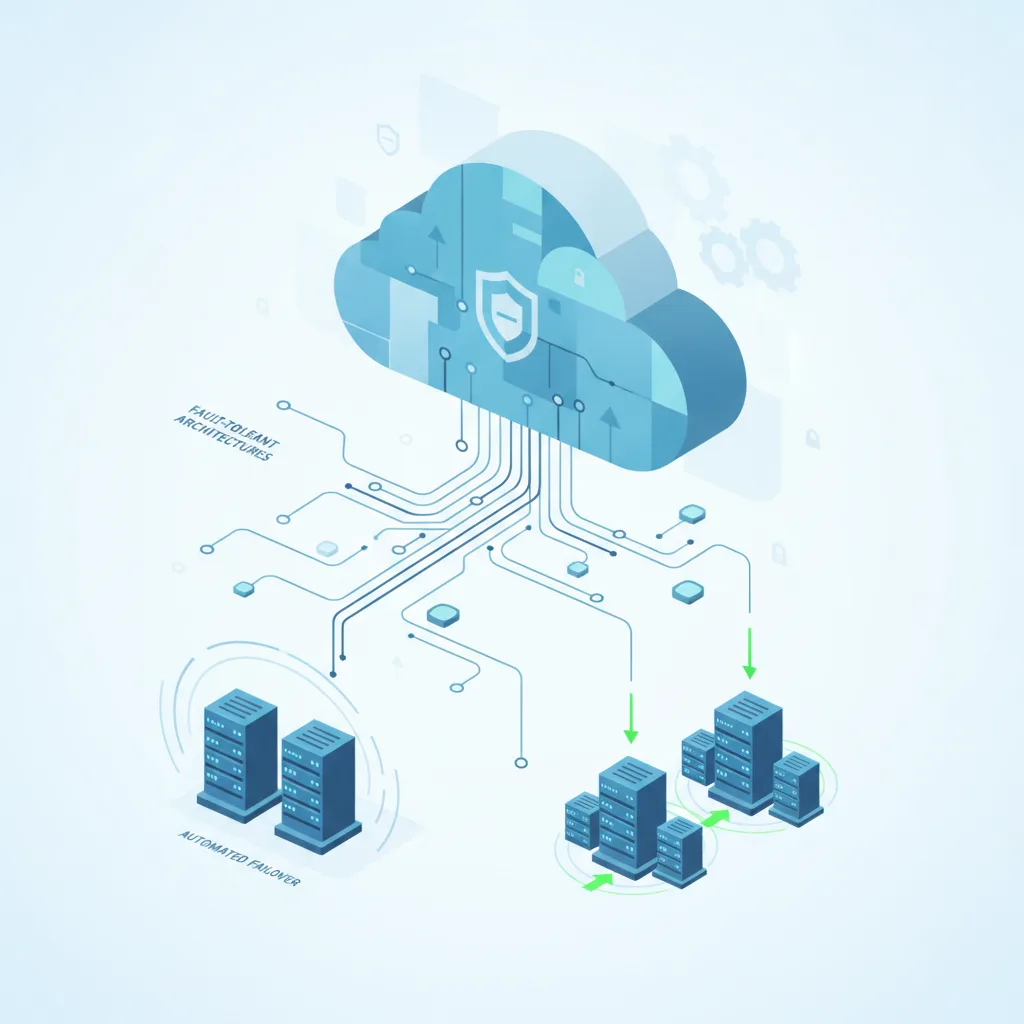
The Role of Automated Failover and Health Checks
Detecting a failure quickly is only half the battle; the system must also respond without human intervention. Manual intervention during a midnight outage introduces inevitable delays and human error. True cloud resiliency relies on automated instrumentation.
Comprehensive health checking should test deep dependencies rather than simply verifying that a web server process is running. A superficial ping returning a 200 OK status can be dangerously misleading if the application can no longer write to its database or communicate with an external identity provider. Modern health probes execute end-to-end synthetic transactions, validating database connectivity, cache responsiveness, and storage bucket read-write permissions.
When a component fails its health check, the orchestration layer must automatically drain traffic, isolate the unhealthy instance, and spin up a fresh replacement. This automated remediation cycle—often referred to as cattle-not-pets infrastructure management—ensures that infrastructure self-heals in seconds rather than hours.
Validating Resiliency Through Chaos Engineering
You cannot know if your architecture is truly resilient until you test it under adverse conditions. Waiting for a real production outage to test your failover mechanisms is a high-stakes gamble. This realization has driven the mainstream adoption of chaos engineering.
Chaos engineering involves intentionally injecting faults into a staging or production environment—such as terminating database instances, artificially inflating network latency, or blackholing traffic to specific availability zones—to observe how the system reacts. By systematically breaking components in a controlled manner, teams can uncover hidden assumptions, race conditions, and brittle dependency chains before they impact real users.
Resiliency Best Practices Checklist for IT Teams
To evaluate and strengthen your current cloud architecture, walk through this practical checklist with your engineering and DevOps teams:
- Audit Your Dependencies: Map every external API, database, and third-party service your application relies on. Identify which ones are critical blockers and which are optional.
- Implement Strict Timeouts: Ensure every network call and database query has explicit, aggressive timeouts configured to prevent thread exhaustion during downstream slowdowns.
- Automate Backups and Test Restores: Regularly schedule database snapshots and object storage backups, but more importantly, automate the restoration process to verify your Recovery Time Objective (RTO) and Recovery Point Objective (RPO).
- Simulate Regional Failures: Conduct tabletop exercises and automated chaos drills to practice failing over traffic between availability zones and regions.
- Centralize Telemetry and Alerting: Consolidate logs, metrics, and distributed traces into a unified observability platform to diagnose cascading failures before they escalate.
Building for the Inevitable
In cloud computing, hardware failures, software bugs, and network disruptions are not matters of if, but when. By embracing stateless designs, implementing rigorous health checks, and validating your systems through intentional fault injection, you transform your infrastructure from a fragile house of cards into a resilient, self-healing ecosystem.
Investing time in architectural resiliency pays off exponentially, protecting your organization's revenue, user trust, and engineering sanity when the inevitable disruptions strike.