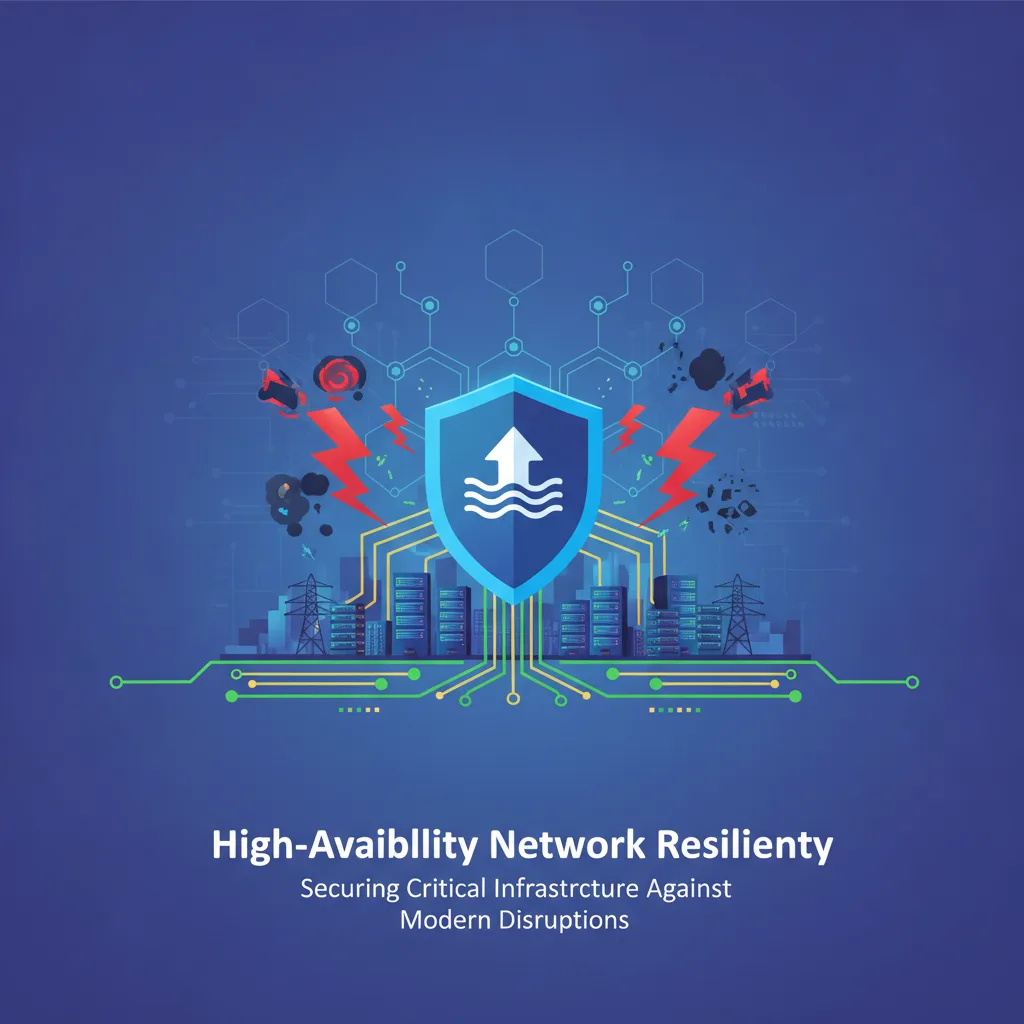
In an era where modern society relies entirely on continuous digital connectivity, the sudden failure of a major communications network sends shockwaves through governments, enterprises, and public services alike. Whether a disruption stems from a sophisticated, multi-vector cyber attack, a catastrophic software misconfiguration, or an unforeseen hardware cascade, the underlying reality remains uncomfortably clear: complex digital ecosystems are inherently fragile unless explicitly engineered for absolute resilience.
For IT decision-makers, architects, and security professionals, maintaining uptime is no longer just about preventing data loss or minor downtime. It is about safeguarding mission-critical functions where even a momentary blackout can paralyze operations. Understanding the anatomy of high-level network failures—and deploying rigorous, defense-in-depth architectural strategies—is essential for keeping critical infrastructure online.
Understanding the Anatomy of Large-Scale Network Disruptions
When high-profile infrastructure goes offline, the root cause is rarely a simple severed cable or a single botched password. Modern enterprise and government networks are hyper-connected webs of software-defined networking (SDN) controllers, virtualized routing functions, cloud-native control planes, and deeply integrated third-party APIs.
This complexity introduces several major vulnerability classes:
- Control Plane Vulnerabilities: In many advanced networks, the control plane (which dictates where traffic goes) is separated from the data plane (which actually carries the traffic). If an attacker or a faulty update compromises the control plane, entire routing tables can be corrupted instantly, isolating vast subnetworks.
- Single Points of Failure in Core Dependencies: Organizations often rely on centralized directory services, DNS resolution providers, or time-synchronization (NTP) servers. A disruption to these foundational utilities can trigger a domino effect across seemingly unrelated systems.
- Supply Chain and Firmware Compromises: Modern networking hardware depends heavily on specialized firmware and third-party software components. A vulnerability buried deep within a routing protocol stack can lie dormant until triggered remotely.
- Cascading Failures from Automated Recovery: Ironically, automated failover mechanisms can sometimes worsen a crisis. If an automated script misinterprets traffic anomalies as an attack, it may aggressively shed load or shut down healthy nodes, inadvertently accelerating a nationwide outage.
Core Strategies for Maximizing Network Resiliency
Building a robust defense against catastrophic network disruption requires shifting the organizational mindset from mere prevention to active operational resilience. You must assume that perimeter defenses will eventually fail and that core systems will experience stress.
1. Implement Zero Trust Architecture for Network Management
Traditional network models rely on a trusted internal perimeter. Once a bad actor breaches the perimeter—or if an internal administrative tool is hijacked—they have lateral movement across the entire infrastructure. Implementing a Zero Trust framework means treating every administrative session, microservice communication, and routing command as untrusted until explicitly authenticated and authorized.
2. Enforce Strict Control Plane Isolation
Management and control traffic should never share the same physical or logical pathways as high-volume data traffic. By establishing out-of-band management networks, systems engineers retain administrative access to critical routers, firewalls, and servers even when the primary data pipeline is completely saturated, degraded, or under active siege.
3. Design for Graceful Degradation
Systems should never fail catastrophically all at once. Architects should design applications and networks to degrade gracefully under pressure. If a primary cloud region or core transit node goes dark, traffic should automatically reroute through isolated edge nodes, shedding non-essential background tasks to prioritize high-priority emergency traffic and baseline user authentication.
Actionable Checklist for IT and Security Teams
To evaluate your organization’s current posture against large-scale network disruption, run through this practical resilience checklist:
- Audit Critical Dependencies: Map out every external DNS, NTP, identity provider, and software repository your infrastructure relies on. Identify alternative or offline-capable fallbacks for each.
- Test Out-of-Band Access: Verify that your IT staff can reboot, reconfigure, and isolate core networking gear entirely independently of the primary production network.
- Simulate Control Plane Failures: Conduct regular tabletop exercises and red-team simulations that mimic the sudden loss of core routing protocols or centralized management dashboards.
- Validate Immutable Backups: Ensure that network configurations, routing policies, and foundational operating system images are stored in air-gapped, immutable repositories that cannot be wiped by ransomware or administrative errors.
- Review Automated Failover Logic: Inspect automated scripts and AI-driven monitoring tools to ensure they cannot aggressively sever healthy redundant paths during unexpected traffic surges.
Building Long-Term Operational Confidence
The threat landscape facing critical infrastructure and enterprise networks will only grow more sophisticated. As systems become more automated and deeply interconnected, the potential blast radius of a single misconfiguration or targeted intrusion expands exponentially.
Mitigating these risks requires moving past complacency and continuously testing the limits of your architecture. By prioritizing strict network segmentation, out-of-band management, and a philosophy of graceful degradation, organizations can ensure they remain standing even when the unexpected occurs.