For decades, the standard playbook for managing complex digital infrastructure has relied on dashboards, metric charts, and alert fatigue. Engineers spend hours configuring thresholds for CPU spikes, memory leaks, and latency shifts, only to be woken up at 3:00 AM by a barrage of alerts that often point to symptoms rather than root causes. While traditional Application Performance Monitoring (APM) and logging tools have evolved significantly, they still share a fundamental limitation: they wait for humans to interpret the data.
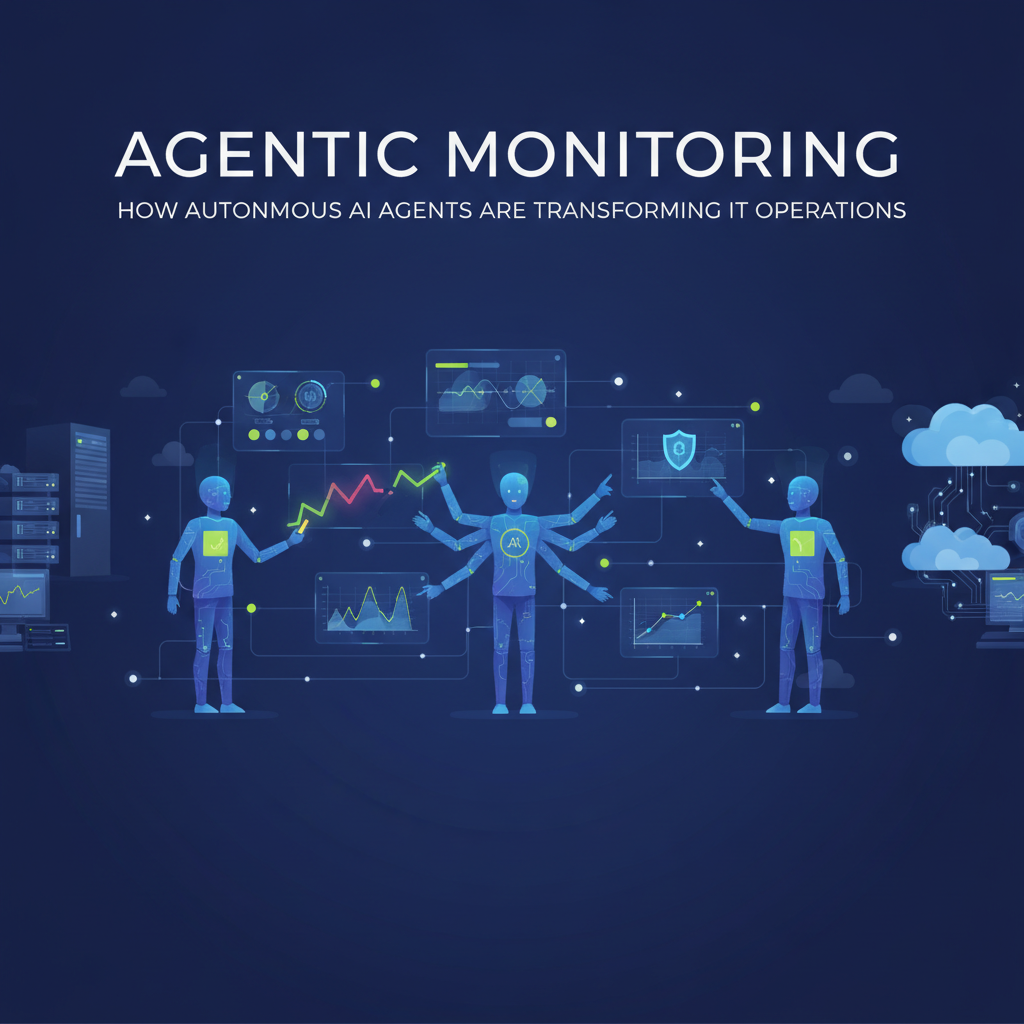
That paradigm is rapidly shifting. We are entering the era of agentic monitoring—a transformative approach where artificial intelligence moves from being a passive reporter of metrics to an active, autonomous participant in system reliability. Instead of simply flashing a red warning light on a screen, modern AI agents are designed to investigate anomalies, correlate logs across distributed microservices, test hypotheses, and, in many cases, execute remediation strategies before a human ever opens a terminal.
What Is Agentic Monitoring?
To understand agentic monitoring, it helps to look at how traditional observability works. Standard monitoring tools execute deterministic rules: If metric X exceeds threshold Y, fire alert Z. These tools are brilliant at telling you that something is broken, but they leave the grueling detective work of figuring out why entirely up to the engineer.
Agentic monitoring replaces or augments these static rules with autonomous workflow loops. Equipped with large language models (LLMs) or specialized decision-making models, these agents have access to toolsets—such as log query interfaces, database metrics, Kubernetes APIs, and source code repositories. When an anomaly occurs, the agent:
- Perceives the anomaly: It detects a departure from normal baseline behavior, even if no strict threshold was explicitly crossed.
- Reasons and plans: It formulates a diagnostic hypothesis (e.g., "The latency spike in the checkout service might be caused by a connection pool exhaustion in the downstream payment database").
- Executes actions: It queries specific logs, runs trace analysis, and checks recent deployment events without human prompting.
- Synthesizes findings: It packages its findings into a comprehensive incident brief or triggers automated remediation scripts based on pre-approved safety protocols.
Why Static Dashboards and Alerts Are Falling Short
Modern cloud-native environments are simply too dynamic for static monitoring to handle efficiently. As architectures expand into distributed microservices, serverless functions, and multi-cloud configurations, the volume of telemetry data generated daily has exploded beyond human cognitive limits.
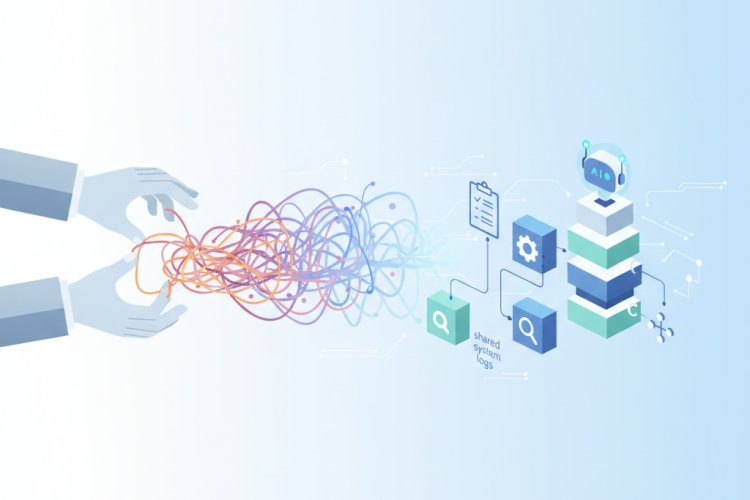
When an incident cascades through a complex system, the initial symptom is rarely the root cause. A failing third-party API can cause thread pools to fill up in an authentication service, which in turn causes timeouts in the frontend application. Human engineers navigating this web of dependencies often waste critical minutes jumping between disparate tools and dashboards just to establish a timeline.
Agentic monitoring bridges this gap by acting as an intelligent force multiplier. It can digest gigabytes of unstructured log data in seconds, mapping out causal relationships that would take human teams hours to untangle.
Key Components of an Agentic Monitoring Pipeline
Implementing an autonomous monitoring framework requires more than just pointing a generic chatbot at your log files. A robust agentic monitoring setup relies on several core pillars:
- Context-Aware Tooling: Agents must be safely sandboxed and granted specific, restricted access to observability APIs, metrics endpoints, and ticketing systems.
- Structured Knowledge Bases: Unlike humans who hold institutional memory in their heads, agents need access to up-to-date runbooks, architecture diagrams, and service dependency maps.
- Guardrails and Human-in-the-Loop Controls: While discovery and diagnosis can be fully autonomous, high-impact remediation actions (such as restarting production nodes or rolling back database migrations) often require explicit human sign-off.
- Feedback Loops: Every incident investigation should teach the agent. When engineers correct an agent's misdiagnosis, that correction must be fed back into its evaluation framework to improve future accuracy.
How to Transition Toward Agentic Workflows
Shifting your organization toward agentic monitoring is an evolutionary process. You cannot simply flip a switch and hand over the keys to your production infrastructure. Here is a practical checklist for introducing autonomous agents into your monitoring stack safely:
- Audit your current telemetry: Ensure your logs, metrics, and traces are clean, structured, and easily queryable via APIs. Agents are only as good as the data they can access.
- Start with read-only diagnostic agents: Deploy agents in a shadow capacity where they receive alerts simultaneously with your on-call engineers. Task them with writing incident summaries and root-cause hypotheses, then evaluate their accuracy.
- Digitize your operational runbooks: Convert tribal knowledge and static PDF runbooks into machine-readable formats that agents can reference during an outage.
- Implement strict security boundaries: Use principle-of-least-privilege access controls. Ensure your agents cannot execute destructive commands without human authorization.
- Measure Mean Time to Resolution (MTTR): Track whether the introduction of agentic workflows actually reduces the time it takes your team to understand and mitigate incidents.
The Changing Role of the SRE and DevOps Engineer
A common concern among IT professionals is whether autonomous agents will render systems engineering roles obsolete. In practice, the opposite is happening. Agentic monitoring does not eliminate the need for skilled engineers; rather, it elevates them from the tedious, repetitive work of log-diving and alert-triage.
Instead of spending their shifts reacting to low-level fires, Site Reliability Engineers (SREs) are becoming orchestrators of these AI systems. They design the guardrails, refine the diagnostic playbooks, and focus on architectural resilience and proactive capacity planning. By offloading the initial cognitive burden of firefighting to agents, engineering teams can build more stable, reliable systems with less burnout.
As agentic monitoring matures, it will cease to be viewed as an experimental feature and become the foundational operating system for how we interact with complex digital infrastructure. Organizations that learn to collaborate effectively with these autonomous diagnostic partners will find themselves better equipped to handle the scale and velocity of modern software delivery.