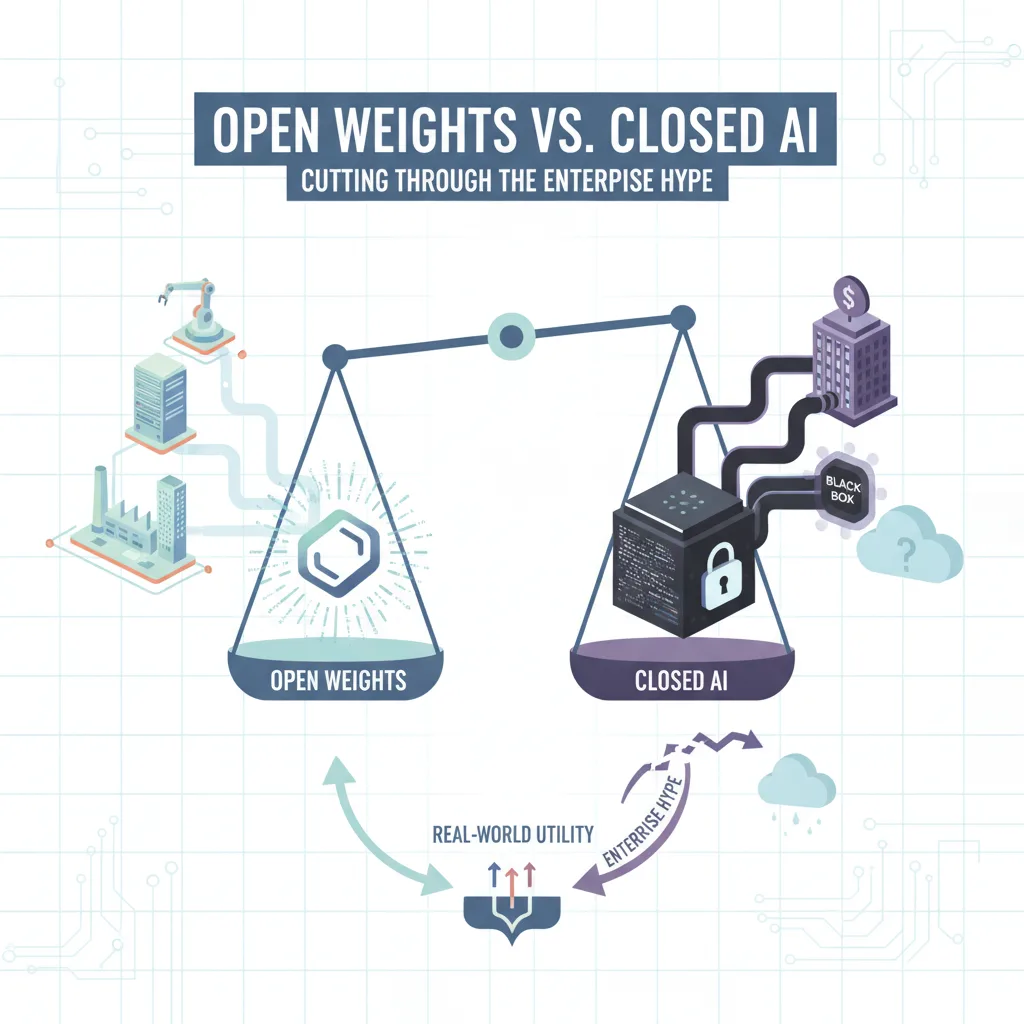
If you have spent any time following tech headlines recently, you know the artificial intelligence landscape moves at a dizzying pace. Every few weeks, a major lab or community collective drops a new model, claims unprecedented benchmarks, and sparks a fresh wave of industry commentary. Among the most significant shifts in recent months is the accelerating release of powerful open-weights models, challenging the monopoly that heavily guarded, proprietary APIs have held over the enterprise market.
For IT decision-makers, architects, and developers, navigating this terrain is increasingly difficult. When every release is met with breathless hype, how do you separate genuine architectural breakthroughs from marketing noise? Understanding the real-world trade-offs between open-weights and closed AI models is essential for building sustainable, cost-effective, and secure technical stacks.
The Evolution of Open Weights: Beyond Community Projects
To understand where open-weights models stand today, it helps to look backward. A few years ago, open-source or open-access models were often academic curiosities or heavily quantized miniatures that lagged far behind commercial flagships in reasoning, context handling, and code generation.
Today, the narrative has fundamentally changed. Top-tier open-weights releases now rival closed systems on many standard benchmarks. Developers can download model weights directly, host them on private cloud infrastructure or local edge hardware, and fine-tune them on proprietary datasets without sending sensitive corporate data to a third-party API.
However, "open weights" is not the same as open source in the traditional software sense. While you get the trained neural network parameters and architecture specifications, you often do not get the original training data, the exact curation pipelines, or the massive compute infrastructure used to create them. Recognizing this distinction is the first step in cutting through the hype.
Weighing the Real Benefits of Open-Weights Models
Adopting open-weights models offers distinct technical advantages that make them highly attractive for engineering teams:
- Data Privacy and Sovereignty: Hosting a model locally or within a private virtual cloud ensures that sensitive enterprise code, customer data, and intellectual property never traverse public vendor APIs.
- Customizability and Fine-Tuning: Unlike hosted APIs where you are restricted to prompt engineering and lightweight adapters, open weights allow deep fine-tuning, domain-specific adaptation, and distillation into smaller architectures.
- Cost Predictability at Scale: While initial hardware provisioning and GPU cluster management require capital, high-volume inference on self-hosted open models often proves significantly cheaper per token than paying commercial API rates indefinitely.
- Operational Resilience: Relying entirely on a third-party API introduces vendor lock-in and vulnerability to sudden pricing shifts, service outages, or policy changes. Self-hosting grants absolute control over your uptime.
The Hidden Costs and Complexities of Self-Hosting
Despite these compelling benefits, the industry hype often glosses over the considerable engineering overhead required to run state-of-the-art open models effectively. Deploying a multi-billion parameter model is vastly different from spinning up a standard web microservice.
Hardware requirements are steep. Running large models efficiently demands high-end GPUs, optimized inference engines (such as vLLM or TensorRT-LLM), and careful management of memory bandwidth and quantization levels. Furthermore, maintaining model security, handling continuous integration for updated model weights, and managing evaluation pipelines require specialized machine learning operations (MLOps) talent that many organizations are still scrambling to hire.
Closed AI Models: Where Proprietary Still Wins
Given the rise of open weights, are closed models becoming obsolete? Not quite. Proprietary systems maintained by major cloud and AI providers still hold distinct advantages for many organizations:
- Zero Infrastructure Friction: Developers can integrate state-of-the-art capabilities with a simple API key, bypassing GPU provisioning, cluster scaling, and infrastructure maintenance.
- Managed Multimodality and Ecosystems: Closed ecosystems often provide seamless, native integration between advanced reasoning, voice processing, image generation, and document parsing tools that would require complex stitching in an open-weights stack.
- Guaranteed Maintenance and Safety Guardrails: Proprietary vendors absorb the immense cost of ongoing safety filtering, red-teaming, and compliance updates, shielding developers from legal and ethical liabilities.
A Practical Evaluation Checklist for Technical Teams
When deciding whether to build your next project on open-weights models or proprietary APIs, avoid relying solely on benchmark leaderboards. Run through this practical evaluation checklist:
- Data Sensitivity Audit: Does your application process HIPAA, GDPR, financial, or proprietary trade secret data that legally or ethically prohibits third-party API transmission? If yes, lean toward open weights.
- Scale and Volume Projections: Calculate your projected token consumption over a 12-to-24-month horizon. At what point does the cost of dedicated inference hardware undercut per-call API fees?
- In-House MLOps Capability: Do you have engineers experienced in quantization, inference optimization, prompt evaluation, and GPU cluster monitoring? If not, factor in the hiring or training curve.
- Latency and Edge Requirements: Does your product require offline functionality or sub-millisecond local execution? Closed APIs cannot compete with localized open weights running on edge hardware.
- Task Complexity: Does the use case require general-purpose creative generation (where closed flagships often excel) or narrow, highly specialized domain reasoning that benefits from fine-tuned open models?
Navigating the Future of Enterprise AI
The false dichotomy that either open-weights or closed models will completely dominate the future is fading. A mature enterprise strategy often embraces a hybrid approach: leveraging closed, highly capable APIs for rapid prototyping and general-purpose administrative tasks, while deploying fine-tuned open-weights models for core product features, data-sensitive workloads, and high-volume operations.
As the tooling around model optimization, distillation, and efficient edge inference continues to mature, the gap between what is possible with open weights versus closed systems will narrow further. By focusing on practical engineering constraints rather than marketing hype, technical leaders can build robust architectures that stand the test of time.