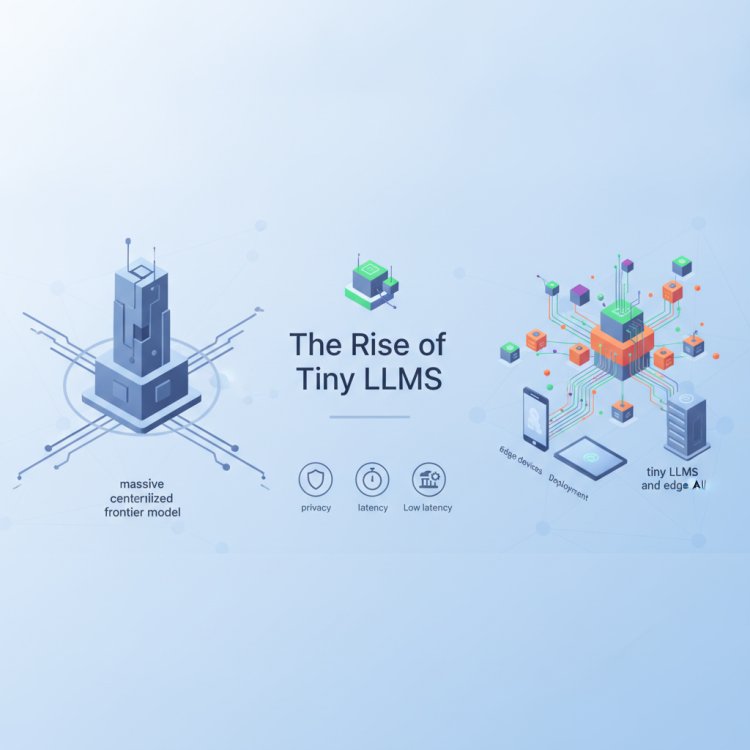
For the past several years, the artificial intelligence landscape has been dominated by a relentless race upward. Tech giants and elite labs poured billions of dollars into training ever-larger frontier models, boasting trillions of parameters, massive cloud cluster requirements, and capabilities that continually pushed the boundaries of natural language generation. Bigger, we were told, was always better.
Yet, a quiet counter-revolution is currently underway in the AI community. Developers, researchers, and IT decision-makers are increasingly turning their attention away from massive cloud-bound APIs and toward a fundamentally different paradigm: tiny LLMs and edge-native artificial intelligence. Driven by breakthroughs in quantization, distillation, and specialized model architectures, sub-billion parameter models are proving capable of handling sophisticated tasks locally, often in mere milliseconds and entirely on consumer-grade hardware or directly inside a web browser.
This shift is not merely about novelty or technical flexing. It represents a fundamental re-evaluation of how businesses and developers deploy machine learning in the real world, prioritizing cost efficiency, low latency, and data sovereignty over raw, brute-force scale.
What Changed? The Shift Toward Efficiency
The pivot from monolithic cloud models to micro language models has been catalyzed by several converging technical trends:
- Advanced Knowledge Distillation: Researchers have gotten exceptionally good at training smaller "student" models to mimic the reasoning patterns and outputs of massive "teacher" models, retaining a surprising percentage of performance at a fraction of the size.
- Aggressive Quantization: Techniques that reduce the precision of model weights (such as down to 4-bit or even lower formats) allow models under one billion parameters to run fluidly on standard CPUs, local microcontrollers, and mobile devices without requiring expensive dedicated GPUs.
- Growing Latency Demands: For real-time applications—ranging from autonomous agents and robotics to responsive user interfaces—a round-trip network call to a remote cloud API introduces unacceptable latency. Local execution eliminates network bottlenecks entirely.
- Intensifying Privacy and Regulatory Pressures: Enterprises are increasingly hesitant to send proprietary code, financial records, or sensitive personal data to third-party cloud servers. Edge AI guarantees that data never leaves the local device or secure corporate perimeter.
Why Micro Models Matter for Developers and IT Leaders
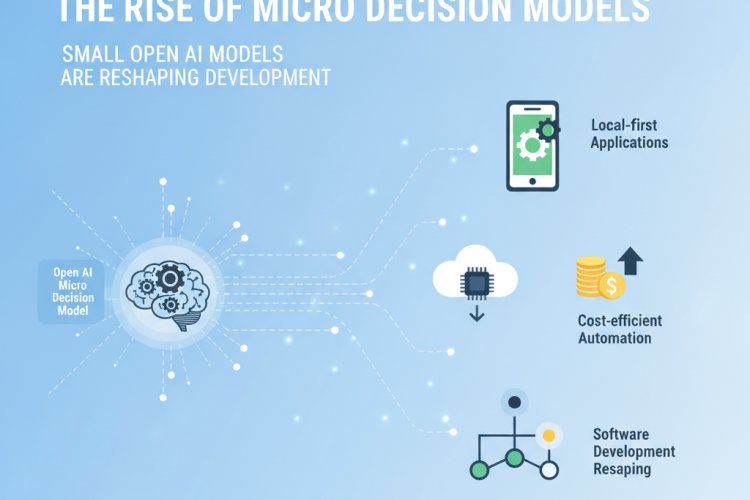
For IT decision-makers and software engineers, the maturation of tiny LLMs unlocks entirely new architectural possibilities. Rather than routing every simple text classification, formatting, or decision-making task through an expensive, rate-limited cloud endpoint, systems can now embed intelligence directly into the application layer.
Consider the implications for local automation and decision agents. When an AI agent needs to evaluate a conditional step or parse incoming telemetry data, doing so locally within 30 milliseconds—rather than waiting 800 milliseconds for a cloud response—transforms a sluggish workflow into a seamless, hyper-responsive experience. Furthermore, because these models can be trained, fine-tuned, or run locally, organizations regain complete control over their software stacks.
Security and compliance teams also stand to benefit enormously. When AI runs on-device, compliance with strict data protection frameworks like GDPR or HIPAA becomes significantly more straightforward, as the surface area for potential data leaks or unauthorized third-party logging is drastically reduced.
Practical Checklist: Evaluating Tiny LLMs for Your Next Project
If you are considering incorporating sub-billion parameter or edge models into your upcoming software architecture, use this practical checklist to guide your evaluation process:
- Define the Scope: Ensure the model is being asked to perform a bounded task (such as entity extraction, routing, syntax checking, or localized classification) rather than open-ended creative reasoning.
- Benchmark Latency and Footprint: Test the model under realistic hardware constraints—including CPU-only environments and memory-restricted mobile or edge devices—to measure exact execution time and RAM consumption.
- Assess Quantization Impact: Compare the accuracy of full-precision versions against quantized formats (like GGUF or ONNX variants) to find the optimal balance between performance and file size.
- Verify Licensing and Provenance: Check the training data and open-source licensing terms of any micro model you plan to deploy commercially to ensure compliance and avoid downstream legal risks.
- Establish Fallback Mechanisms: Design your application architecture to gracefully fall back to a larger cloud model or human review queue when the tiny model encounters low-confidence scenarios.
Looking Ahead: The Distributed Future of AI
The future of artificial intelligence will not be dictated solely by who owns the largest data center or the most expensive cluster of GPUs. As micro models continue to improve in reasoning capability and efficiency, the frontier of innovation is expanding outward to the edge.
For businesses and developers willing to look beyond the hype of massive cloud-based LLMs, embracing edge AI offers a compelling path forward: faster applications, tighter data security, drastically reduced operational costs, and true independence from centralized infrastructure. The intelligence revolution is scaling down, and in many cases, smaller is turning out to be remarkably better.