For years, the Internet of Things (IoT) conversation has been dominated by massive scale: billions of connected sensors, vast cloud data lakes, and complex centralized machine learning models crunching telemetry from across the globe. But while cloud-connected smart thermostats and industrial fleet trackers grab the mainstream headlines, a quieter, much more fascinating shift is happening at the microscopic edge.
Engineers, researchers, and open-source hardware developers are increasingly focusing on hyper-local, sub-millimeter automation. Inspired by projects ranging from open-source lab equipment to ultra-precise micro-manipulators, the maker and professional engineering communities are building connected hardware that operates with breathtaking physical precision. However, as with any emerging tech trend, it is crucial to separate genuine engineering breakthroughs from vendor hype. Let's examine what is actually changing in the world of edge IoT and micro-automation, and how to evaluate these technologies for real-world deployment.
The Evolution of Edge IoT: Moving from Cloud Telemetry to Local Actuation
Traditional IoT architectures were built on a simple premise: gather data at the edge, send it to the cloud, let heavy compute analyze it, and send a command back down. For simple monitoring tasks, this works fine. But when you introduce tight physical feedback loops—such as aligning fiber-optic cables, manipulating biological samples, or assembling micro-electronics—cloud round-trip latency becomes an insurmountable bottleneck.
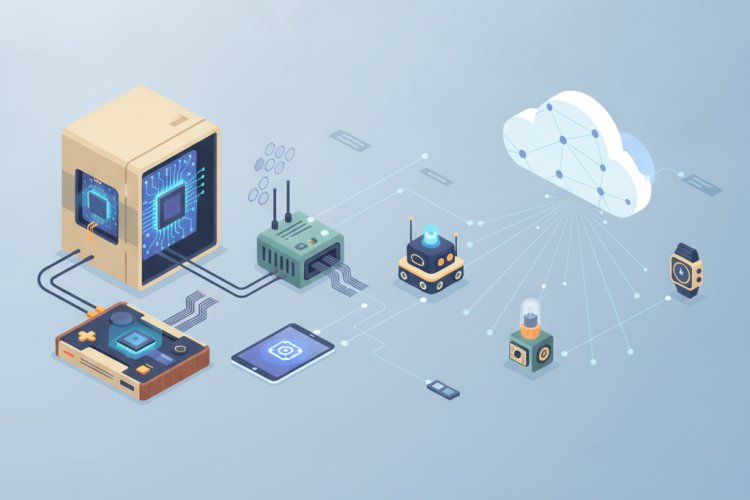
The latest wave of connected hardware solves this by pushing intelligence and control down to the bare metal of the device. Modern microcontrollers pack enough processing punch to handle complex kinematics, sensor fusion, and local decision-making without ever pinging an external server.
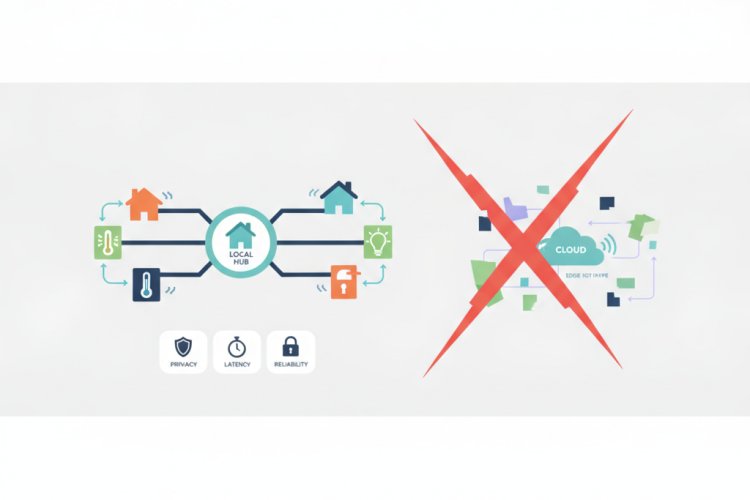
This shift toward localized autonomy brings several distinct advantages:
- Zero-Latency Feedback: Sub-micrometer motion control requires instantaneous adjustments based on optical or tactile feedback, which cannot tolerate network jitter.
- Enhanced Security and Privacy: By processing sensitive telemetry and visual data locally, organizations reduce their attack surface and avoid compliance hurdles.
- Resilience to Network Outages: Localized edge devices continue operating seamlessly even if the facility loses its internet connection entirely.
- Reduced Bandwidth Costs: Streaming high-frequency sensor data or raw video feeds to the cloud is prohibitively expensive; processing it at the edge eliminates unnecessary data transmission.
Separating Open Source Hardware Reality from Commercial Hype
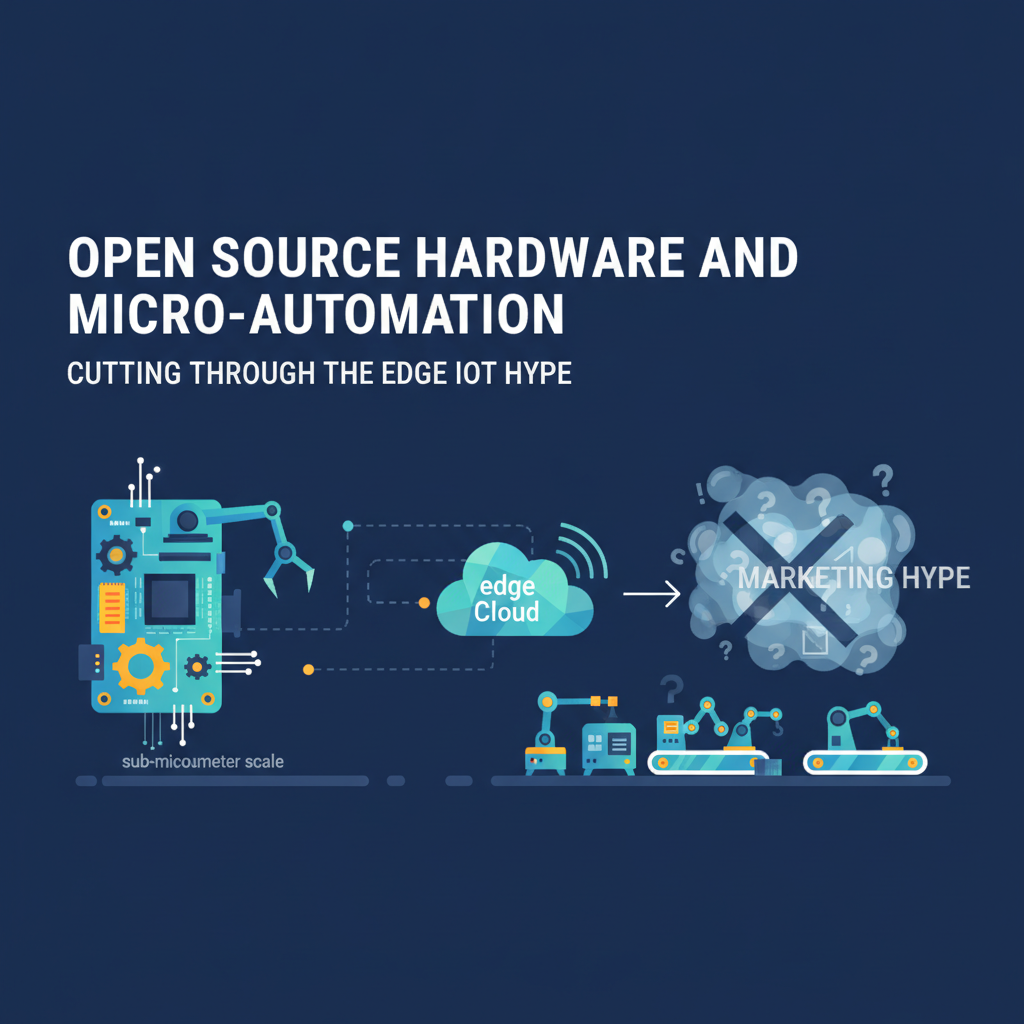
The rise of open-source hardware toolkits—from modular micro-positioning stages to open lab automation platforms—has democratized access to tools that once cost tens of thousands of dollars. Yet, whenever open-source tooling intersects with industrial automation, marketing hype tends to follow close behind.
It is easy to find vendor claims of "plug-and-play micro-automation" or "instantaneous sub-micron precision for pennies." Seasoned IT decision-makers and engineers know that physical hardware rarely behaves so neatly out of the box. Here is a practical framework for cutting through the marketing noise when evaluating edge hardware projects:
- Verify Mechanical Repeatability vs. Absolute Accuracy: A device might be able to return to the exact same coordinate repeatedly (high repeatability), but that is very different from hitting a universally calibrated global coordinate (absolute accuracy). Look for verified empirical benchmarks, not theoretical tolerances.
- Examine the Software Supply Chain: Open-source hardware is only as good as its software stack. Check whether the firmware is actively maintained, relies on standard protocols, and uses transparent libraries rather than proprietary, obfuscated binaries.
- Assess Environmental Tolerance: Lab bench prototypes often fail in real-world deployment environments due to thermal expansion, vibration, and electromagnetic interference. Ensure the hardware specs match your actual operational conditions.
- Look at Integration Hooks: Real-world IoT deployments require interoperability. Can the hardware easily speak standard industrial or IoT protocols (such as MQTT, ROS, or REST APIs), or does it require a fragile custom integration layer?
Real-World Use Cases for Micro-Precision Edge Devices
Where do these high-precision, locally controlled edge devices actually deliver ROI? Rather than trying to apply them to generalized enterprise tasks, organizations are finding success in niche, high-value verticals where precision matters most.
In academic research and biotechnology, open-source micro-manipulators and automated positioning platforms allow laboratories to scale up complex experiments at a fraction of the cost of proprietary lab equipment. By utilizing off-the-shelf micro-controllers paired with custom 3D-printed or CNC-milled mechanical assemblies, labs can iterate on custom automation tools rapidly.
Similarly, in electronics manufacturing and quality assurance, edge-computed optical inspection systems use localized vision models to spot microscopic soldering defects in real time. Because the inference happens directly on the device mounted to the assembly line, defective parts are flagged instantly, stopping production errors before they compound.
Building a Pragmatic Strategy for Connected Hardware
As you plan your infrastructure or engineering roadmap for the coming year, approaching connected hardware with a healthy dose of skepticism is your best defense against costly missteps. Embrace the modularity and cost-advantages of modern open-source design, but always validate the physical and software layers independently.
Focus your investments on systems that emphasize interoperability, transparent documentation, and localized resilience. By prioritizing robust engineering fundamentals over flashy marketing claims, you can build reliable edge IoT architectures that truly stand the test of time.
The future of connected hardware isn't about massive, opaque cloud systems controlling everything from afar. It is about smart, precise, local devices working together reliably at the edge—right where the physical work actually happens.