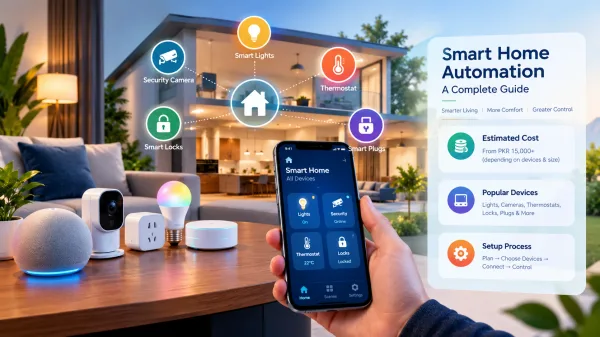

For years, the promise of the Internet of Things (IoT) has felt like a perpetual work-in-progress, and autonomous smart devices are the latest chapter. Consumers and enterprise facility managers alike have been pitched a utopian vision of connected hardware: a world where smart bulbs anticipate your mood, thermostats preemptively adjust to shifting weather fronts, and industrial sensors magically optimize factory floors without human intervention. Yet, anyone who has ever spent forty minutes troubleshooting a misbehaving smart plug or re-pairing a zigbee mesh network knows the frustrating gap between marketing fiction and engineering reality.
Recently, however, the conversation around connected hardware has shifted dramatically. Driven by advancements in edge computing, local machine learning models, and autonomous software agents, smart devices are moving past rigid conditional rules—the classic "if this, then that" triggers—toward more adaptive, autonomous behaviors. But as vendors race to rebrand their existing ecosystems with buzzwords, it is more important than ever to separate genuine architectural breakthroughs from recycled marketing fluff.
Let us examine what is actually happening in the connected hardware space, what makes modern autonomous smart devices different, and where the boundaries of hype truly lie.
The Evolution from Rule-Based Triggers to Autonomous Smart Devices
Traditional smart home and industrial IoT systems rely heavily on deterministic automation. A sensor measures a variable—such as temperature, motion, or current draw—and evaluates it against a static threshold. If the threshold is crossed, a command is sent to an actuator. While effective for simple tasks, this approach scales poorly in complex environments. A drop in temperature might mean someone opened a window, or it might mean the HVAC system is failing, or it might simply be a transient reading.
The latest wave of connected hardware introduces a higher degree of local autonomy:
-
Contextual Awareness: Instead of reacting to isolated data points, modern devices aggregate multiple sensor streams locally to understand a broader state.
Local Inference: Rather than relying solely on cloud-based round-trips, more devices now embed low-power neural processing units (NPUs) capable of running quantized machine learning models directly on the edge.
Adaptive Learning: Systems can observe user patterns over weeks or months, adjusting behaviors dynamically without requiring manual schedule programming.
This shift from static scripts to probabilistic, context-aware execution is the defining characteristic of modern autonomous smart devices.
Real-World Use Cases: Where Autonomy Delivers Value
To understand the true utility of these systems, we need to look past flashy consumer demos and examine where autonomous hardware solves genuine friction points.
1. Predictive Facility Maintenance and Edge Diagnostics
In commercial buildings and industrial settings, connected vibration and acoustic sensors have evolved beyond simple anomaly alarms. Modern edge hardware can process continuous waveform data locally, using lightweight anomaly detection models to flag bearing wear or motor misalignment weeks before failure occurs. This local processing ensures that massive streams of raw telemetry do not choke corporate networks, saving bandwidth while ensuring real-time responsiveness.
2. Adaptive Energy Management Grids
Smart energy management has moved beyond basic time-of-use scheduling. Autonomous metering devices and smart circuit panels now coordinate with local solar arrays, battery storage, and dynamic grid pricing signals. Instead of following a rigid routine, the hardware autonomously decides when to store energy, when to draw from batteries, and when to throttle non-essential heavy loads based on live weather forecasts and historical consumption models.
3. Resilient Local-First Environments
One of the most significant architectural trends in connected hardware is the push toward local-first execution. Early smart devices were entirely dependent on cloud servers; if an internet connection dropped, your smart home effectively became a collection of expensive, non-functional plastic objects. Today’s robust IoT architectures prioritize local controllers that communicate over standardized local protocols (such as Thread and Matter), ensuring that autonomous routines execute reliably even during a total WAN outage.
Separating Reality from Marketing Hype
Whenever a technology sector undergoes a paradigm shift, marketing departments rush to apply the latest buzzwords to legacy products. When evaluating new connected hardware, IT decision makers and tech-curious consumers should keep a sharp eye out for common exaggerations.
"True autonomy in IoT is not about letting your devices make arbitrary decisions in the cloud; it is about providing edge hardware with enough local context to act reliably, securely, and privately within its physical environment."
Consider the following points of distinction when analyzing the current market:
- Hype: "Our toaster uses generative AI to optimize your breakfast."
Reality: Over-engineered cloud dependencies for trivial tasks introduce unnecessary latency, security attack surfaces, and privacy risks. If a task does not require complex reasoning, a simple microcontroller and a deterministic rule are vastly superior. - Hype: "Completely autonomous and maintenance-free."
Reality: All hardware degrades, firmware requires updating, and sensors drift. Autonomous systems still require robust monitoring, secure update pipelines (OTA), and clear fallback states when sensor data becomes corrupted. - Hype: "Military-grade cloud security."
Reality: The most secure IoT architecture is often the one that minimizes external data exposure. Local-first processing that keeps telemetry inside the local network perimeter provides inherently better privacy than systems that ship every sensor reading to a third-party cloud.
Checklist: Evaluating Autonomous IoT Hardware for Deployment
Whether you are outfitting a smart enterprise facility or building out a robust home automation lab, use this checklist to assess whether a connected hardware product delivers genuine capability or merely expensive hype:
-
Local Operation Capability: Does the device function fully without an active internet connection, or does it brick when the cloud service goes down?
Open Integration Standards: Does it support vendor-agnostic protocols (like Matter or Zigbee) or open APIs, or does it lock you into a proprietary walled garden?
Data Privacy and Telemetry Control: Can you audit what data the device collects, and is local processing prioritized over mandatory cloud offloading?
Firmware Lifecycle Transparency: Does the manufacturer commit to a clear schedule for security patches and long-term software support?
Fail-Safe Architecture: When the automation logic fails or sensor data becomes anomalous, what is the default physical state of the hardware?
The Path Forward for Connected Hardware
The maturation of autonomous smart devices represents a genuine leap forward in how we interact with our physical surroundings. By combining energy-efficient edge silicon with intelligent local software architectures, modern IoT hardware is becoming more reliable, responsive, and private than ever before.
However, technology buyers must remain discerning. The most effective deployments are rarely those plastered with the newest marketing buzzwords; they are the ones built on solid networking foundations, local resilience, and transparent security practices. As the hardware ecosystem continues to evolve, keeping a focus on engineering fundamentals will ensure you invest in tools that genuinely simplify operations rather than adding unnecessary complexity.
Related guides
- Local-first smart home architecture: cutting through the connected hardware hype
- Smart home automation: devices, cost and how to start
- Hardware-level cybersecurity: protecting modern infrastructure
- IT infrastructure and security services
For a general overview, see the Wikipedia article on Internet of Things.