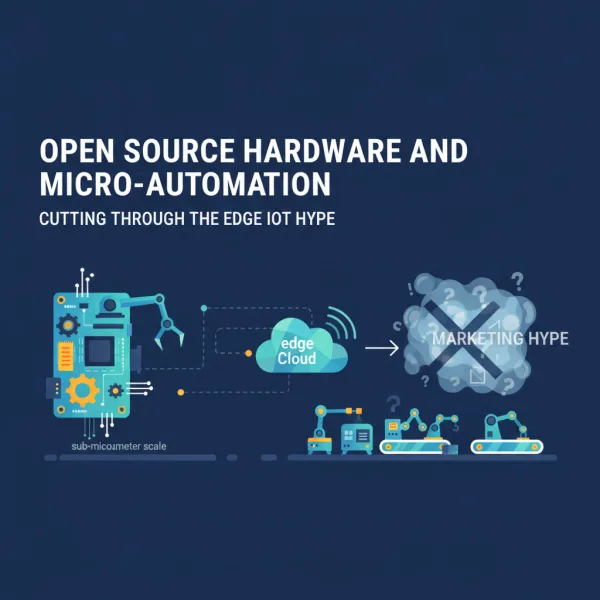

For years, the Internet of Things (IoT) conversation has been dominated by wireless sensors, smart thermostats, and cloud-connected lighting. But as the boundaries of connected hardware expand, a more physically ambitious trend is taking shape at the edge: open-source hardware for micro-robotics and modular desktop automation. Driven by a surge in accessible manufacturing, affordable microcontrollers, and transparent design schematics, developers and engineers are increasingly experimenting with room-scale grippers, articulated arms, and physical actuators that bridge the gap between digital software and the physical world.
Yet, whenever physical hardware intersects with open-source communities, hype follows closely behind. Tech headlines frequently paint a picture of automated, modular robots effortlessly solving complex logistics or household chores straight out of the box. To understand where this technology actually stands, we need to separate genuine engineering breakthroughs from speculative marketing buzz.
The Evolution of Connected Hardware: Moving Beyond Basic Sensors
Traditional IoT architectures are fundamentally passive. They gather telemetry data—temperature, humidity, motion, or power consumption—and pipe it up to a cloud dashboard or a local hub for analysis. The feedback loop is typically digital, triggering an alert, adjusting a thermostat, or cutting power to a faulty circuit.
Micro-robotics and open-source physical hardware introduce an active feedback loop. They do not just observe the physical environment; they manipulate it. When you combine modern edge processing with open-source mechanical blueprints, you get systems capable of localized sorting, precision material handling, and automated physical testing.
This shift is heavily supported by several maturing technologies:
-
Standardized Microcontrollers: Powerful, low-cost processing units capable of executing lightweight machine learning models locally without relying on high-latency cloud round-trips.
Accessible Fabrication: High-precision desktop 3D printing and laser cutting allow developers to iterate on custom mechanical chassis in hours rather than weeks.
Open-Source Toolchains: Transparent CAD files, firmware, and schematics mean that hardware development is beginning to mirror software development—forkable, modular, and collaboratively reviewed.
Separating Reality from Hype in Open-Source Hardware Robotics
While the prospect of building a functional robotic arm or automated gripper for a fraction of enterprise hardware costs is compelling, developers entering this space often encounter severe friction. Let us dissect what is truly viable today versus what remains firmly in the realm of hype.
The Hype: Plug-and-Play Automation for Everyone
The Claim: Open-source hardware blueprints allow anyone to download a design, print the parts, assemble them in an afternoon, and deploy a robust, industrial-grade automation tool in their workspace or home.
The Reality: Physical hardware is notoriously unforgiving. Unlike software, which can be easily patched and redeployed across millions of devices, physical components wear down, experience thermal drift, and suffer from mechanical tolerance issues. Assembling a complex robotic gripper requires meticulous calibration, understanding torque limits, managing power distribution, and dealing with firmware bugs that can cause physical damage if misconfigured.
The Reality: Rapid Prototyping and Edge-Integrated R&D
The Claim: Open-source hardware acts as an affordable, highly customizable testbed for edge intelligence and machine learning models that require physical actuators.
The Fact: This is where the ecosystem truly shines. For engineering teams, academic researchers, and advanced hobbyists, open-source robotics provide a low-cost sandbox. Instead of spending thousands of dollars on proprietary industrial hardware just to test how a computer vision model interacts with a physical object, developers can assemble a custom gantry or gripper, hook it up to a local edge processor, and iterate rapidly.
Key Architectural Considerations for Connected Hardware Projects
If you are planning to integrate open-source hardware or micro-robotics into your next IoT or automation pipeline, approaching the project with a software-engineered mindset is essential. Here is a practical checklist to guide your evaluation:
- Evaluate Mechanical Tolerances: Ensure that the chosen open-source design accounts for standard 3D printing shrinkage, material fatigue, and structural load limits. Never assume a printed plastic joint can handle industrial-grade torque without reinforcement.
- Prioritize Local-First Control: Avoid cloud-dependent actuation dependencies. For safety and latency reasons, motor control, collision detection, and emergency stop protocols must run on local microcontrollers or edge devices.
- Examine the License and Ecosystem Health: Check whether the project has an active community, well-documented APIs, and clear licensing (such as CERN OHL or GPL). Stale repositories with undocumented CAD files will quickly drain your engineering resources.
- Plan for Maintenance and Spares: Hardware breaks. Ensure you have easy access to replacement stepper motors, bearings, belts, and fasteners before committing to a custom mechanical build.
- Incorporate Safety Fail-Safes: Physical automation introduces real-world hazards. Implement hardware-level kill switches and current-sensing limits to prevent motors from burning out or causing injury if an obstruction occurs.
- Retro hardware retrofitting for edge IoT
- Hardware-level cybersecurity: protecting modern infrastructure
- IT infrastructure and security services
The Road Ahead for Edge IoT and Robotics
The convergence of open-source hardware, affordable actuation, and localized edge intelligence is undeniably transforming how we think about connected devices. We are moving away from an era where IoT was confined to flat screens and plastic enclosures, stepping instead into a world where physical micro-automation is accessible to anyone with a workbench and a vision.
However, success in this space requires patience and a healthy skepticism toward overnight miracles. By respecting the physical limitations of mechanical hardware while leveraging the incredible collaborative momentum of open-source design, developers and IT innovators can build resilient, highly customized systems that bridge the digital and physical divide.
As the tooling continues to mature, the true value of open-source hardware will not be found in pre-packaged perfection, but in the agility it grants developers to experiment, iterate, and build smarter physical systems from the ground up.
Related guides
For a general overview, see the Wikipedia article on open-source hardware.