The conversation around artificial intelligence in software development has shifted dramatically. For years, the baseline expectation of an AI coding assistant was simple: autocomplete the next few lines, suggest a regex pattern, or explain a snippet of legacy documentation in a chat window. While useful, these tools remained passive utilities that required constant human intervention.
Today, the industry is moving past simple autocomplete toward something far more systemic: agentic coding workflows. Instead of just writing functions, autonomous and semi-autonomous coding agents are designed to reason through multi-step engineering tasks, orchestrate test suites, debug build failures, and refactor entire directory structures. Driving a significant portion of this evolution is the rapid maturation of open-weight models, giving development teams unprecedented control, transparency, and customization over how their automated workflows operate.
From Passive Assistants to Autonomous Agents
Traditional coding assistants function reactively. A developer encounters a problem, frames a prompt, evaluates the output, and manually copies and pastes the result into an IDE. The human remains the sole orchestrator of context, task breakdown, and validation.
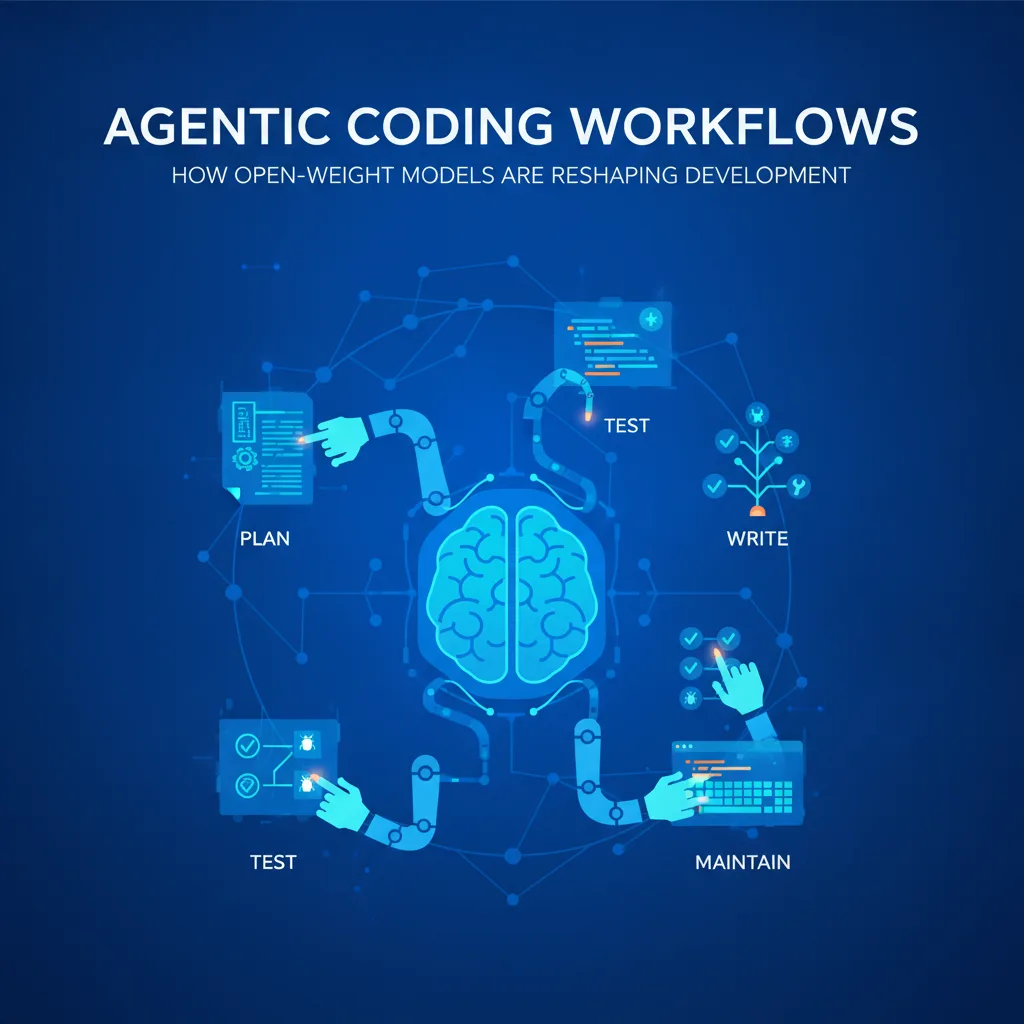
Agentic workflows flip this dynamic. An autonomous coding agent is given a high-level objective—such as "implement a rate limiter middleware for the API gateway and ensure all unit tests pass." From there, the workflow typically executes through a recursive loop:
- Planning: The agent analyzes the repository structure, identifies relevant files, and outlines a step-by-step implementation strategy.
- Execution: It writes or modifies code across multiple files, handling syntax and imports natively.
- Verification: The agent invokes local test runners, linters, or build scripts to check its own work.
- Iteration: If an error occurs, the agent reads the stack trace, diagnoses the root cause, and applies a fix without human intervention.
This shift transforms developers from line-by-line scripters into system architects and reviewers, managing workflows rather than keystrokes.
The Role of Open-Weight Models in Agentic Development
As coding agents demand deeper reasoning capabilities, the choice of underlying model architecture has become critical. While closed, proprietary cloud APIs have long dominated the conversation, recent advances in open-weight models—particularly larger-scale architectures optimized for tool use and reasoning—are leveling the playing field.
Open-weight models offer unique advantages for engineering teams building internal automation pipelines:
- Data Privacy and Security: Enterprise codebases often contain proprietary logic and sensitive security configurations. Running capable open-weight models locally or within a private virtual private cloud (VPC) ensures that proprietary code never leaves organizational perimeters.
- Fine-Tuning Flexibility: Every engineering team has unique coding standards, architectural patterns, and internal libraries. Open-weight models can be fine-tuned on internal repositories to understand company-specific idioms far better than generic cloud models.
- Cost Predictability: High-frequency autonomous agents make thousands of reasoning calls per task. Relying entirely on per-token cloud pricing can make heavy automation cost-prohibitive, whereas self-hosted open-weight models offer fixed infrastructure costs.
Key Components of Robust Agentic Coding Workflows
Deploying coding agents successfully requires more than just pointing a capable model at a Git repository. A production-ready agentic workflow relies on a carefully structured technical stack.
Here are the core pillars required to build reliable coding automation:
- Context Retrieval and Indexing: Large codebases exceed standard context windows. Agents need semantic search engines and abstract syntax tree (AST) parsers to pull only relevant file snippets into memory.
- Sandboxed Execution Environments: Because agents execute code, run tests, and install packages, they must operate inside secure, isolated containers to prevent unintended system modifications or security breaches.
- Deterministic Guardrails: Autonomous workflows need strict boundaries—such as limiting file write access to designated directories or requiring human approval before merging pull requests.
- Structured Logging and Observability: Debugging an agent that failed silently halfway through a ten-step refactor is notoriously difficult. Comprehensive audit trails are essential for tracking an agent's reasoning steps.
Overcoming the Hurdles of Code Automation
Despite their immense potential, agentic coding workflows are not a silver bullet. Developers adopting these tools often encounter predictable friction points.
One major challenge is "context drift." As an agent modifies multiple files over a long session, its internal representation of the codebase can drift from reality, leading to cascading logic errors. Mitigation requires frequent context refreshes and strict modularization of tasks.
Another hurdle is over-reliance on synthetic validation. While an agent might write code that passes existing tests, it may miss edge cases or introduce subtle architectural debt that only an experienced human reviewer can spot. Successful adoption treats agents as junior engineers requiring supervision rather than autonomous seniors.
The Future of Software Engineering Workflows
The integration of open-weight models into agentic coding workflows marks a permanent change in how software is built. As these systems become faster, more reliable, and better at long-range planning, developers will spend less time wrestling with boilerplate code and configuration files, and more time designing resilient, scalable systems.
By balancing the autonomy of AI agents with rigorous security, sandboxing, and human oversight, engineering teams can unlock a new tier of productivity without compromising the integrity of their codebases.
Related guides
- Autonomous AI agents: from chatbots to workflow orchestrators
- Why AI agents need structured documentation, not infinite memory
- Agentic AI and automation services
For background on the models behind these agents, see the Wikipedia article on large language models.