For decades, discovering a new material—whether a room-temperature superconductor, a high-efficiency semiconductor, or a novel alloy for quantum computing hardware—was an excruciatingly slow process of trial and error. Researchers spent years in the laboratory synthesizing compounds, testing their properties, and often coming up empty-handed. Today, the narrative has shifted dramatically. Headlines frequently announce that autonomous AI agents have cracked the code, discovering hundreds of thousands of stable materials or uncovering exotic compounds in a matter of weeks.
As tech-curious professionals and IT decision-makers, it is easy to get swept up in the enthusiasm. But when we look past the press releases, what is the actual state of AI-driven materials science? Where is the real technological progress happening, and where does the hype machine take over? Let us break down how machine learning is truly altering the physical sciences, and what it means for the future of tech infrastructure.
The Promise: How AI Accelerates Discovery
To understand why machine learning has become so central to materials science, we have to look at the sheer scale of the chemistry space. The number of possible stable inorganic crystals and organic molecules is virtually infinite—far larger than human researchers could ever test manually.
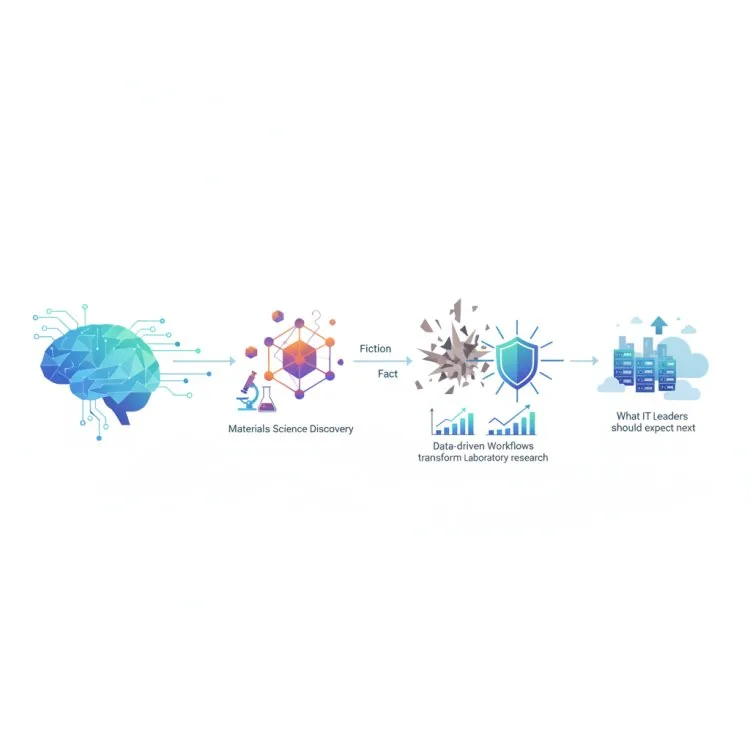
AI steps in by drastically compressing the timeline of the scientific method through three primary mechanisms:
-
Predictive Modeling: Using graph neural networks and deep learning models trained on decades of crystallographic databases, algorithms can predict the stability and properties of hypothetical materials with striking accuracy before a single gram is mixed in a lab.
Autonomous Agent Orchestration: Modern multi-agent systems can parse academic literature, design chemical synthesis pathways, and even operate robotic wet-labs to test compounds around the clock without human fatigue.
Property Optimization: Instead of searching blindly, algorithms can navigate multi-dimensional property spaces to optimize specific traits, such as thermal conductivity, magnetic susceptibility, or electron mobility.
This is not science fiction. Major research institutions and tech giants have successfully used computational pipelines to surface thousands of candidate materials that were previously unknown to science.
Separating Reality from Hype
While the computational generation of candidate materials is genuinely revolutionary, a massive chasm exists between discovering a material in silico (on a computer) and deploying it in a commercial product. This is where the marketing hype often diverges from scientific reality.
When evaluating news about breakthrough materials, keep these critical distinctions in mind:
-
Synthesis vs. Simulation: Generating a crystal structure in a simulation environment is very different from physically synthesizing it in a laboratory. Many AI-suggested compounds are thermodynamically unstable or require extreme, commercially unviable pressures and temperatures to create.
Scalability and Yield: A material might exhibit extraordinary properties in a microscopic lab sample, but if it cannot be manufactured at scale with consistent purity, it remains an academic curiosity.
The Validation Bottleneck: AI generates hypotheses at a blistering pace, but physical validation remains slow. Laboratories can only test and characterize a fraction of what algorithms propose, creating a severe verification bottleneck.
Understanding these hurdles helps us appreciate that AI is not a magic wand that instantly hands us advanced hardware. Rather, it is an exceptionally powerful filter that narrows down an infinite ocean of possibilities into a manageable shortlist for human scientists.
What This Means for Enterprise and IT Strategy
You might wonder why enterprise IT leaders and software developers should care about magnetic semiconductors or crystal structures. The connection lies in infrastructure. The hardware that powers our cloud datacenters, edge devices, and networking equipment is ultimately bound by the physical limits of materials science.
As silicon approaches its physical scaling boundaries, the future of high-performance computing depends on novel materials—whether that means more efficient semiconductors, spintronic devices, or quantum interconnects. The digitization of materials science signals a broader convergence between data science and physical engineering.
Here is a practical checklist for organizations looking at emerging tech intersections:
-
Audit Your Data Quality: Just as in enterprise AI, garbage in means garbage out in materials informatics. Ensure your internal data pipelines are structured, clean, and accessible if you are experimenting with domain-specific models.
Adopt a Skeptical Lens on Vendor Claims: When evaluating hardware or infrastructure vendors boasting about revolutionary materials, ask for peer-reviewed validation, synthesis metrics, and real-world production timelines.
Foster Interdisciplinary Teams: The most exciting breakthroughs happen when data scientists, software engineers, and domain experts (physicists, chemists) share a common language and workflow.
Monitor Quantum and Edge Hardware Evolution: Keep an eye on how laboratory discoveries in semiconductors and magnetism begin trickling down into silicon manufacturing roadmaps over the next three to five years.
Looking Ahead
The marriage of artificial intelligence and materials science represents a fundamental shift in how we build the physical foundations of our digital world. While we must remain vigilant against exaggerated claims of overnight miracles, the underlying momentum is undeniable. We are moving from an era of accidental discovery to an era of programmatic design.
As computational power grows and our simulation models become more refined, the gap between digital prediction and physical reality will continue to narrow. For technologists and IT leaders, staying informed about these foundational shifts ensures you are never caught off guard when the next wave of hardware transformation hits the market.
More about materials science
Want to go further with materials science? These Netstech guides and services are a good next step: