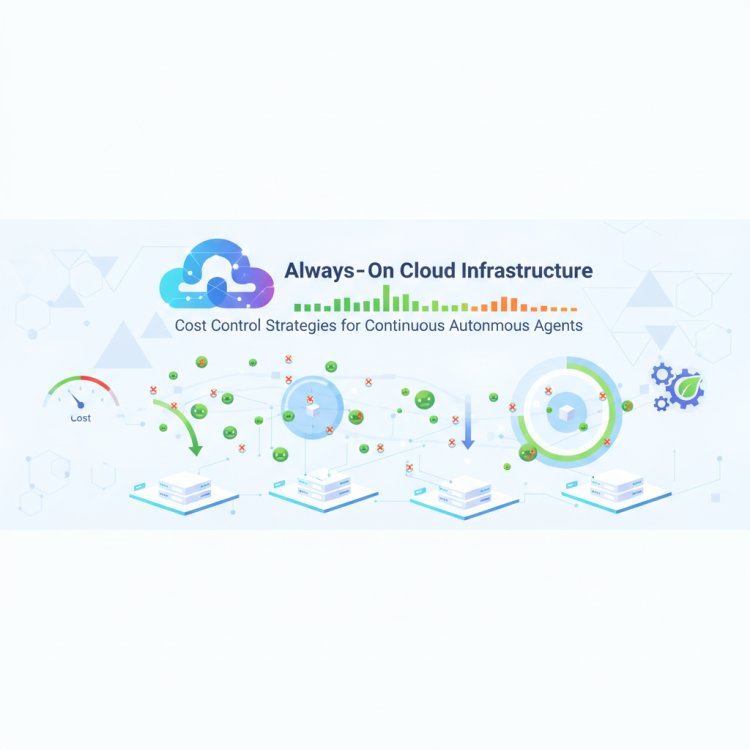
The modern cloud landscape is undergoing a quiet, structural transformation. For years, the prevailing architectural paradigm was reactive and episodic: an event triggers a serverless function, a user requests a web page, a batch job runs overnight, and resources scale back down to zero. Today, engineering teams are increasingly deploying always-on cloud components—ranging from continuous monitoring agents and persistent background data pipelines to autonomous helper systems that run around the clock.
While these persistent workloads offer unprecedented responsiveness and automation capabilities, they introduce a stark economic reality. When infrastructure runs 24/7, traditional auto-scaling logic breaks down. A resource that stays provisioned continuously cannot rely on short-term traffic dips to trim its monthly bill. As engineering teams pivot toward always-on patterns, mastering continuous cloud cost management has shifted from a nice-to-have optimization exercise to a core survival metric for modern IT organizations.
The Hidden Economics of Always-On Cloud Workloads
When computing infrastructure transitions from on-demand to persistent, the math changes drastically. In an on-demand model, over-provisioning a server by 20% for a few peak hours results in a negligible financial footprint. Scale that same 20% buffer out across 720 hours in a month, however, and the waste compounds exponentially.
Furthermore, always-on architectures often require persistent state management, constant network polling, and background synchronization tasks. These operations consume steady streams of CPU, memory, and egress bandwidth. Without deliberate architectural guardrails, teams frequently find that the operational convenience of continuous background automation is matched only by a sudden, unexpected spike in their monthly cloud bill.
To capture the benefits of continuous infrastructure without breaking the budget, engineering and FinOps teams must adopt a dual-pronged approach: refining core architectural patterns to handle persistence efficiently, and implementing aggressive resource governance.
Architectural Patterns for Efficient Persistent Infrastructure
Optimizing always-on cloud systems begins at the drawing board. If a workload must run continuously, its underlying design must be optimized for baseline efficiency rather than peak-burst capability.
- Right-Sizing for Baselines: Unlike elastic web apps that need headroom for traffic spikes, continuous background agents often consume a predictable, flat amount of resources. Profile your persistent workloads carefully to match them with hyper-specific instance types rather than defaulting to general-purpose tiers.
- De-coupling State from Compute: Keep your continuous compute nodes stateless where possible. By offloading session data, logs, and state caches to distributed, low-cost object storage or managed caching layers, your compute instances become completely disposable—making it easier to migrate them to cheaper capacity pools on the fly.
- Asynchronous Event Buffering: Instead of having always-on agents directly poll external APIs or databases in tight loops, introduce durable message queues. Batching operations and processing them asynchronously prevents unnecessary resource thrashing and stabilizes CPU utilization.
A Practical Checklist for Always-On Cloud Cost Optimization
Implementing financial accountability for continuous workloads requires a structured routine. Use the following checklist to audit your always-on infrastructure and uncover hidden waste:
- Commit to Savings Plans and Reserved Instances: For workloads guaranteed to run 24/7 for the next year or three, avoid on-demand pricing entirely. Lock in baseline capacity using long-term commitments to slash compute costs by up to 40% or more.
- Audit Egress and Network Traffic: Always-on agents frequently communicate with external services, multi-region databases, or logging endpoints. Map your data transfer paths to eliminate cross-AZ (Availability Zone) and cross-region traffic charges that accumulate silently over time.
- Implement Strict Observability Thresholds: Set up anomaly detection alerts that trigger not just on outright failures, but on gradual resource creep. If a background agent's memory footprint slowly drifts upward over a 72-hour period, your monitoring tool should catch it before it forces a costly node upgrade.
- Leverage Spot and Transient Capacity for Fault-Tolerant Tasks: Even within a continuous architecture, certain sub-tasks (like log aggregation or periodic data indexing) can tolerate interruptions. Route these secondary background tasks to spot instances with automatic fallback mechanisms.
Balancing Innovation with Financial Governance
The push toward more autonomous, always-on cloud systems represents a major leap forward for developer productivity and system responsiveness. However, technology leaders must ensure that engineering velocity does not outpace financial governance. By treating cloud cost optimization as an architectural constraint rather than an afterthought, teams can harness the full potential of continuous infrastructure without suffering from end-of-month budget shock.
Ultimately, sustainable cloud architecture requires a culture where developers understand the financial implications of their code running around the clock. As continuous automation becomes the standard expectation for modern software, aligning technical design with rigorous FinOps practices will separate efficient engineering organizations from the rest.